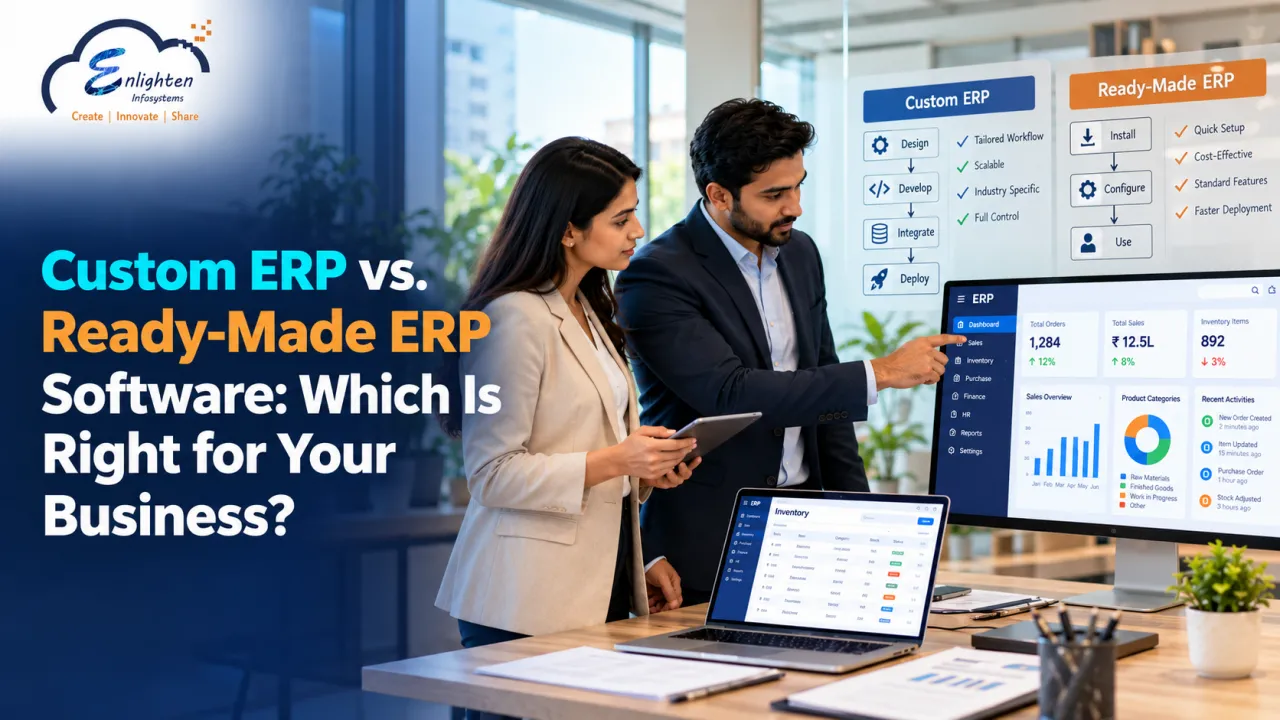
Custom ERP vs. Ready-Made ERP Software: Which Is Right for Your Business?
Every business wants to save time, reduce costs, and manage its daily work without confusion. However, as a business grows, managing sales, stock, accounts, employees, and customer information using different tools can become difficult. This is where Enterprise Resource Planning (ERP) software can help.
An ERP system brings different business activities together in one place. It helps teams share information, reduce manual work, and make better decisions. But when choosing an ERP system, businesses often face one important question: should they build a custom solution or choose ready-made software?
An understanding of the difference between custom ERP and ready-made ERP systems will assist you in selecting an ERP system that meets your budget, day-to-day operations, and long-term objectives. Now we'll examine both types of systems, their advantages and disadvantages, along with some considerations that you need to make prior to choosing an option.
What Is Custom ERP Software?
Custom ERP software is designed and developed to meet the specific needs of a business. Instead of changing your working methods to match an existing system, you can build software around your business processes.
For example, a manufacturing company may need special features to track raw materials, production schedules, product quality, and finished goods. A standard ERP system may not cover every requirement in the way the company expects. A custom solution can be designed to manage these activities according to its workflow.
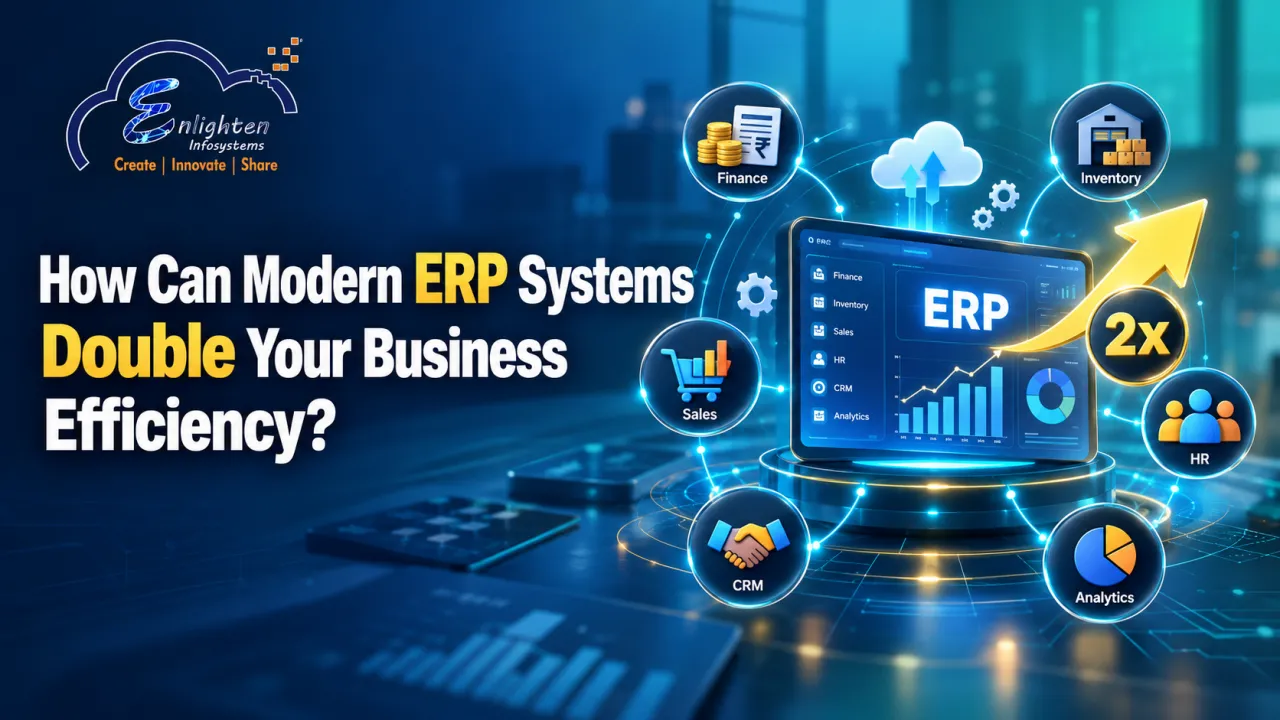
Custom ERP software can include modules such as:
● Financial management and accounting
● Inventory and warehouse management
● Human resources and payroll
● Sales and customer management
● Purchase and supplier management
● Production planning and reporting
● Business process automation
Businesses can start with the features they need most and plan additional modules as their requirements change.
Explore our guide to choosing the best ERP development company in India for custom ERP solutions to understand how tailored ERP systems can streamline business processes and improve operational efficiency.
What Is Ready-Made ERP Software?
Ready-made ERP software, also called off-the-shelf ERP software, is a pre-built system designed for use by many businesses. It usually comes with standard features for common business activities, such as accounting, inventory, purchasing, and employee management.
Businesses may choose the most appropriate package for their needs, customize the configuration, and then implement the software. For some products and those that require a lot of initial configuration, this method will allow businesses to use an ERP system much faster than if they were to have a completely custom-built ERP system.
Ready-made ERP software may be suitable for businesses that have standard processes and do not require many special features.
Some common benefits include:
● Pre-built business functions
● Faster implementation in many cases
● Lower initial development costs
● Regular software updates from the vendor
● Access to vendor support and documentation
● Existing integrations with selected business tools
However, businesses may need to adjust their workflows to match the software. Additional features or integrations may also require extra payment. Businesses can also consider IT services in Vadodara for professional guidance when selecting, implementing, or integrating ERP software.
Custom ERP vs. Ready-Made ERP Software: Key Differences
Both options help businesses manage their operations, but they differ in how they are built, priced, and maintained.
|
Factor |
Custom ERP Software |
Ready-Made ERP Software |
|
Development |
Built around specific business requirements |
Pre-built for a wider range of businesses |
|
Initial cost |
Usually higher because development is required |
Often lower, depending on the licence and setup |
|
Implementation |
Can take longer, depending on complexity |
Often quicker to implement |
|
Flexibility |
Features can be designed around business needs |
Depends on available settings and customisation options |
|
Business workflows |
Can follow specific company processes |
May require changes to existing processes |
|
Integration |
Can be designed to connect with required systems |
Depends on available connectors and APIs |
|
Maintenance |
Requires a planned maintenance and support arrangement |
Usually supported by the software vendor |
|
Scalability |
Can be planned around expected business growth |
Depends on the product's features and pricing |
|
Software updates |
Managed through the development and maintenance process |
Usually provided by the vendor |
|
Long-term costs |
Include development, hosting, support and upgrades |
May include subscriptions, licences, add-ons and customisation |
The right choice depends on your business requirements. A lower starting price does not always mean lower long-term costs, and a custom solution is not automatically the better option for every company.
Benefits of Custom ERP Software
1. Built Around Your Business Needs
Every business has its own way of working. A trading company may need advanced stock tracking, while a service company may need project scheduling and employee allocation.
Custom ERP development allows you to choose features based on your actual requirements. This can reduce unnecessary steps and make daily work easier for employees.
2. Greater Flexibility and ERP Customization
With a custom system, you have more control over workflows, user roles, reports, and business rules. You can also plan ERP customization around specific needs that standard software cannot meet easily.
For example, if your company follows a unique approval process for large orders, the ERP can be designed to support those steps.
The aim is to make the system work for your team rather than force your team to follow unsuitable processes.
3. Better Support for Business Growth
As your company grows, you may add new employees, branches, products, or services. Your software must be able to support these changes.
Custom ERP solutions can be planned with future requirements in mind. New modules, integrations, and reports can be added when needed, provided the system has been designed to support them.
This makes custom ERP worth considering for businesses with changing or specialized requirements.
4. Integration With Existing Business Tools
When a business uses different software applications for accounting, managing customers, selling products/services, and tracking inventory, if they cannot talk to each other, employees will often have to re-enter data into multiple systems.
A custom ERP can be designed to connect with existing business applications through suitable integrations and APIs. This helps information move between departments and reduces repeated manual work.
Benefits of Ready-Made ERP Software
1. Faster Implementation
Ready-made ERP software already includes common business features. Companies can configure the available modules instead of building every function from the beginning.
This can help businesses that need a system quickly, although data migration, staff training, and complex integrations can still take time.
2. Lower Initial Investment
A ready-made ERP system generally costs less to start using than a fully custom-built solution because the core software has already been developed.
However, businesses should also check license fees, subscription charges, additional user costs, support plans, and the price of extra features before choosing a package.
3. Regular Updates and Vendor Support
Most established ERP vendors provide software updates, technical documentation, and support options. These can help businesses maintain their systems and access new features.
The level of support depends on the vendor and the selected plan, so it is important to understand what is included before purchasing.
4. Suitable for Standard Business Processes
If your business follows common processes for accounting, purchasing, payroll, and inventory, a ready-made ERP system may already cover most of your needs.
In this case, paying to build a complete system from scratch may not be necessary.
Which ERP Is More Cost-Effective in the Long Run?
Cost is one of the biggest factors when comparing custom ERP vs. ready-made ERP software. However, the best way to compare them is to look beyond the initial price.
A ready-made ERP may have a lower starting cost, but expenses can increase through subscriptions, additional users, paid modules, and customization.
A custom ERP may require a larger initial investment. You must also budget for hosting, security, technical support, maintenance, and future improvements.
Before making a decision, calculate the total cost of ownership over three to five years. Consider:
● Software development or license fees
● Implementation and configuration
● Data migration and integration
● Employee training
● Hosting and infrastructure
● Maintenance and technical support
● Software upgrades and additional features
You should also consider the time employees spend on manual tasks. A system that reduces repeated work and prevents avoidable errors may offer better value over time.
Which ERP Is Better for Growing Businesses?
The right choice depends on how your business operates today and where you want it to go.
Ready-made ERP software may be suitable if:
● Your business has standard operational requirements.
● You need to implement a system quickly.
● Your budget for the initial investment is limited.
● The available features meet most of your needs.
● You prefer vendor-managed updates and support.
Custom ERP software may be suitable if:
● Your business follows specialized workflows.
● Existing software does not meet your operational needs.
● You require specific integrations or reports.
● Your processes change frequently as the business grows.
● You need greater control over system features and development priorities.
For ERP software for growing businesses, it is also worth considering a hybrid approach. You could use a ready-made ERP for standard functions and develop custom modules for specific business needs.
This approach can help avoid the cost of building everything from scratch while providing flexibility where it matters most.
How to Choose the Right ERP Development Partner
Choosing the right software is only one part of the process. The development or implementation partner also plays an important role in the success of your ERP project.
Before selecting a partner, consider these points:
1. Understand your requirements: List the problems you want the ERP to solve and the departments that will use it.
2. Check relevant experience: Look for a team with experience in ERP development, integrations, databases, and business process automation.
3. Discuss future growth: Make sure the proposed system can support your expected users, data, and operational needs.
4. Understand the costs: Ask for a clear breakdown of development, implementation, hosting, maintenance, and support charges.
5. Plan security and data migration: Discuss user access, data protection, backups, and how information will move from your existing systems.
6. Ask about ongoing support: Find out who will manage updates, fix issues, and help your team after the system goes live.
A good development partner should understand your business challenges before recommending a solution.
Learn how custom ERP software development for businesses can help automate workflows, integrate business operations, and support long-term growth.
Why Choose Enlighten Infosystems for ERP Development?
Enlighten Infosystems is an IT services and software development company based in Vadodara, Gujarat. The company provides ERP development and other technology solutions designed to support business operations, improve efficiency, and address specific software requirements. With experience across different technology services, the About Enlighten Infosystems section provides more context about the company and its approach to delivering business-focused software solutions.
Its ERP services include custom ERP development, cloud-based solutions, business system integrations, finance and HR modules, supply chain and inventory management, and ongoing support.
For businesses considering custom ERP solutions, the first step is to understand which processes need improvement and whether a ready-made, customized, or hybrid system is the best fit.
Enlighten Infosystems is also a provider of ERP software development services to companies that require software developed specifically for the way they operate. As an ERP development company in india, our team will assist you with assessing your needs and then developing a proper solution.
The focus should be on selecting technology that solves real business problems, supports employees, and can adapt as the company grows.